Τρίτη 30 Ιουνίου 2020

Civil disobedience contesting Cyprus’ partition: citizens acting against crossing points closure


Gregoris Ioannou

Photo: Gregoris Ioannou
As of mid-March 2020, crossing the dividing line between the northern and the southern part of Cyprus has been forbidden. Although the closure was termed temporary and only made possible through the appeal to, and exploitation of, the public health crisis provoked by global pandemic Covid-19, the process through which this was done revealed yet once more the social dynamics of partition politics. This article discusses citizen action contesting the closure of the crossing points in late February and early March, before the general lock-down measures were imposed by the Republic of Cyprus and the Turkish Cypriot administration in the northern part of the island. 
The aim, like my ontological perspective and involvement in this, is dual. On the one hand, to provide an outline of the context and an analysis of the implications of the act of civil disobedience and on the other, to intervene in the on-going public debate in Cyprus about the separation of Greek Cypriots and Turkish Cypriots to which the currently closed crossing points are subsumed. Being at the same time a peace activist and a sociologist, a participant, and a researcher in the social mobilisation, allows me to have direct access to empirical information as well as theoretical tools with which to interpret the event and assess its significance. This also poses a challenge as multiple balances must be kept – between the objective facts and the subjective and inter-subjective meanings, the political and the analytic levels, the reporting, and the explanatory functions. Yet, being able to comprehend the connection between the biographical narrative and the macro-historical plane and situate the former within the latter is a key parameter of what C. Wright Mills defined more than half a century ago as the sociological imagination. This insight can illuminate the nexus of peace activism and public sociology of which this article is an embedded example.

Photo: Gregoris Ioannou
Division, crossings and closure
The inter-ethnic conflict between Greek Cypriots and Turkish Cypriots marked the transition of Cyprus from a British colony to independent statehood and the two main communities’ failure to collaborate in power-sharing in the bi-communal framework of the Republic of Cyprus established in 1959 resulted in violence in the early 1960s and their total separation, completed in 1974 after Greek coup d’etat and the Turkish invasion. Until 2003 when the first checkpoints opened allowing movement across the cease-fire line, contact between Greek Cypriots and Turkish Cypriots was effectively prohibited. The peace and reunification movement that emerged since the late 1980s, practicing rapproachment through bi-communal meetings abroad, at the Ledra Pallace hotel serving as the UN headquarters in the buffer zone, and in the mixed village Pyla situated at the intersection of territory controlled by the Republic, the Turkish army and one of the two British Military Bases, remained relatively small and too weak to influence politics.
It was only in the 2000s that substantial progress was made in the negotiations and with the imminent entry of the Republic of Cyprus into the EU and after mass protests by the Turkish Cypriots against their nationalist leadership it became possible to have the checkpoints opened in 2003. Although the reunification of the island was not achieved, after the majority of Greek Cypriots rejected the UN Plan in 2004 in a referendum, and although subsequent round of negotiations failed the open crossings for 17 years allowed the retreat of prejudice and suspicion and the improvement of the climate and relations between Greek Cypriots and Turkish Cypriots. More importantly the open crossings allowed some space, literally and politically, to the peace movement in both communities to pursue the goal of Cyprus reunification.
President Anastasiades’ move to unilaterally close four of the seven checkpoints under his government’s control (the remaining two of the nine open are under the control by the British Sovereign Bases on their southern part) in late February using Covid-19 as an excuse came as a surprise to everybody for many reasons. It was illegal since it contravened the Green Line Regulation with the EU only informed post-facto, and it was irrational because no other measures were taken at the time in relation to Covid-19 – there were no restrictions and not even any checks in the airports to flights arriving from countries with a high number of infections. Politically it was provocative as it was implemented without consulting the UN or the Turkish Cypriot side, it ignored the Bi-communal Technical Committee on Health and effectively alluded that the threat to public health came from the Turkish Cypriot community in the north.
When challenged by the peace and reunification movement, the Turkish Cypriot leadership but also the UN itself, Anastasiades’ government framed it as a sovereignty issue effectively confirming that the move was really about the politics of Cyprus division. A few weeks later, after Covid-19 did arrive in Cyprus, ironically on the same day south and north separately from UK and German travellers respectively, the sovereignty game, diachronically structuring the “Cyprus problem” and central in the maintenance of Cyprus division was played out even more sadly with respect to the reporting of incidences and deaths. The Republic of Cyprus restricted its reporting only to those occurring in the south, as if the northern territory was a separate country. And with one exception concerning the sharing of medical supplies coming from China, there was no cooperation between the two sides in dealing with Covid-19 whatsoever.

Photo: Gregoris Ioannou
Pushing the barricades
On a practical level the closure of the four crossings neutralized some of the remaining ones which were used in conjunction with the closed ones while it increased the traffic on others. The closure of the Ledra street checkpoint, the busy pedestrian crossing point in the heart of old Nicosia, however, was of immense symbolic significance and the biggest blow to the peace and reunification movement. Ledra street was opened in 2008 after coordinated and simultaneous pressure from peace activists north and south and has since become the reference point for the reunification movement. Ledra street checkpoint became thus naturally the main site where the contestation of the closure was played out in 2020. When Anastasiades government announced the closure on 28th February spontaneous reactions begun which coalesced into a demonstration the following day, Saturday, when several hundred activists pushed down the barricade erected by the police and stormed into the buffer zone. There, Greek Cypriots met dozens of Turkish Cypriots who joined them from the north and effectively the checkpoint was re-opened for a few hours. This unprecedented act of civil disobedience illustrated both the significance of crossings for many Cypriots as well as their readiness to act to keep the checkpoints open.
Following the citizens’ action of 29th February Anastasiades’ government used the nationalist media, the far right and the police to defame, vilify and frighten the peace movement and prevent a repeat of citizens forcing open the checkpoint again. The media isolated a ten second scuffle of a protester pushing a soldier, in any case illegally present in the demilitarized buffer zone and doing police work, using it to frame the protesters as violent. Beyond the attempt to delegitimize the peace movement, the promotion of a “law and order” frame aimed at bullying the peace activists. The police harassed individuals threatening to charge them for “illegal assembly” and “rioting” and the far-right staged protests in the next days, demanding the closure of all checkpoints. The peace movement was not cowed however and despite several reservations the core peace activists were able to gather a bigger crowd on the following Saturday 7th March. An also bigger crowd of Turkish Cypriots entered the buffer zone and pushed from the north making the Republic of Cyprus’ police lose its temper and use spray against them.
Returning to the bigger picture
Beyond allying with the Greek Cypriot far-right wing and quasi-fascist ELAM, which boasted that closing the checkpoints was its own suggestion, by unilaterally closing the four crossing points Anastasiades also intervened in Turkish Cypriot politics. In addition to frustrating the Turkish Cypriot leader Mustafa Akıncı’s efforts to promote collaboration in the context of the Bicommunal Technical Committee for Health, the creation of a climate of tension in bi-communal relations was expected to benefit the nationalist Ersin Tatar who heads the government in the north and who is contesting Akıncı for the community’s leadership in the upcoming presidential elections. In fact, Tatar did pick up the Greek Cypriot challenge and responded by unilaterally closing three different additional crossings and finally all of them.
The populist exploitation of Covid-19 for nationalist purposes initially by Anastasiades’ government and subsequently also by Tatar’s government in the north, and their game of competition about the image of sovereignty which has continued also in the context of the current gradual re-opening, is bound to have deeper repercussions in the future. The three-month closure brought about again the absolute separation of the two communities reminiscent of the pre-2003 situation. More importantly it contributed further to the imaginary of Cyprus’ partition as the ‘normal’, as the default position in the current critical times whereby the two parts of the island operate as if they are different countries antagonising even with respect to public health. However, the civil disobedience of the peace activists against the closure has also left its historical imprint.   
It will be difficult to keep the checkpoints closed for too long. The pressure from the EU and the UN, is expected to grow as the UN Secretary Generally is due to submit his Report to the Security Council in July. Already the frequent protests from Turkish Cypriots who work in the south and the dissatisfaction of a significant segment of the public in both communities has forced some developments. In late May the two sides, after having already relaxed most of the restrictions imposed in March, had their first exchange of epidemiological data but in June the two sides entered a new competition about when and how and for whom some of the checkpoints were to re-open resulting in two unilateral moves again opening up some crossings but not the two main pedestrian ones in Nicosia. However, the making of a privately conducted and paid Covid-19 test a prerequisite for crossing (only once for the north but every three days for the south) in practice restricts crossing even via the few checkpoints that have reopened. Even if all nine crossings re-open again without restrictions in the coming months, the closure and semi-closure regimes have set precedents. If the authorities did it once, they can do it again, if there is say a second wave of Covid-19 or something else that can be termed as “emergency” in the future. At the end of the day it remains up to the citizens themselves to ensure that their contestation of closed checkpoints, ethnic separation and the division of their country is a factor to be reckoned with.  
Gregoris Ioannou is a political sociologist and a Research Fellow at the University of Glasgow. His research focuses on labour relations, class conflicts, social movements and contentious politics, and the South European crisis. His recent publications have dealt with trade unions, populism and left radicalism, the division of Cyprus and the labour market in the crisis. His book “The normalization of Cyprus’ partition among Greek Cypriots: political economy and political culture in a divided society” is forthcoming in September by Palgrave Macmillan while earlier versions were published in Greek (2019) and Turkish (2020).

Τρίτη 7 Απριλίου 2020

Authoritarianism masking incompetence? The case of the Republic of Cyprus

Article published in Open Democracy

Authoritarianism, left unchecked to shape the public discourse, can self-propel and legitimise itself, diverting the blame for a degraded public health system from the state onto society.
Gregoris Ioannou
At the end of February, as the Covid-19 crisis developed in Europe, governments began to adopt measures which evolved by March into various sorts of lock-down aiming to impose physical distancing between individuals. In a context in which, after decades of neoliberal policies, underfunding and privatisation, national public health systems lacked the capacity to cope with the surge of demand provoked by the global pandemic, lock-downs were deemed essential.
At the same time as a substantial part of economic activity was suspended, governments pledged to support workers who had to abstain from work and businesses that had to shut, including the announcement of several social policy and temporary tax relief measures. Where adopted, lock-down measures typically included the prohibition of congregations and restriction of non-essential travel, granting enhanced powers to the police to enforce this where needed. The executive authority meanwhile assumed more powers, ostensibly to upgrade health care capacities and deal with the economic consequences mostly via executive decrees instead of proper legislation.
This is as far as the generalisation can go. When one gets into the specifics of each European state, significant divergences emerge not only with respect to the timing, the scope and the details of the measures adopted but also with respect to their focus, their direction and their logic or absence thereof. While for example some, such as the centre-left coalition government in Spain, have brought private hospitals under state control, others, such as the right-wing government in Greece, paid private hospitals premium money to use their facilities. Whereas the centre-left government in Portugal decided to give to all migrants and asylum seekers temporary citizen rights in order to automatically incorporate them into the social security and health care systems, in Bulgaria the army which was given police powers by the conservative government , set up checkpoints outside Roma neighbourhoods to control their movement.
While in some countries the emergency measures were assigned a fixed term of weeks or months, in others this was left open for review at an unspecified date in the future. Although violating civil liberties in unprecedented ways in peace-time democracy, in most cases these regulations were instituted “legally”, voted in by parliaments and following the stipulated constitutional procedures. In some east and south European states however, such niceties were deemed unaffordable luxuries in times of crisis.

An absent EU

The EU so far has been largely absent from the whole crisis management operation and only came to post facto accept or turn a blind eye to the initiatives taken by the nation-states even when these violated treaties, principles, rules and regulations. A lot has been said about the economic consequences of the lock-down measures and on the sealing of national borders. A lot of speculation is also being expressed about the magnitude of the debt crisis looming ahead and the future of the Eurozone and the EU amidst resurgent divisions and polarisation among member-states. There is less discussion on the authoritarian drift observed and what there is tends to focus on eastern Europe, which already manifested authoritarian trends before the Covid-19 crisis. Hungary is the most cited example where Orban’s government secured the power to rule by decree without parliamentary scrutiny, and restrict free speech without an end date.

The public health system

The authoritarian measures of movement restriction are justified through a discourse of “science”, with lock-down presented as the implementation of physical distancing. While the example of China and the recommendations of the World Health Organisation (WHO) are cited by European states for this, most of them underplay or ignore the other half of the story: the rapid and massive diversion of resources into the public health system undertaken by China and the widespread testing of the population.
As the WHO tirelessly insists, “lock-down on its own cannot solve the problem”, it seems that at least some European states are using authoritarian measures of population control as a substitute for the needed upscaling of public health system capacity. Through the enhanced “legitimacy” assumed as a result of the fear that has overtaken wide sections of society and through their friendly media some governments are able to frame the public health crisis as a public security crisis, invoking war imagery and discourse that shifts public debate and the public attention from state failures to “disobedient” individual citizens who need disciplining through ever-escalating collective punitive measures. The Republic of Cyprus is one of the most extreme examples of this in Europe and deserves to be more closely examined.

Authoritarian Cyprus

As Covid-19 began to spread in Europe in February, the Cyprus government initially ignored it taking no measures at all with respect to its busy airports and making no attempt to boost the capacity of its newly instituted NHS system (GESY) and its already crumbling public hospitals.
At the end of the month it surprised everybody by unilaterally closing 4 of the 7 crossings under its control to the northern part of the country in a nationalist and populist move, alleging that the threat to public health came from the Turkish Cypriot community, provoking the reaction of the peace and reunification movement and shifting public attention away from public health to the politics of Cyprus’ division.
Soon the nationalist political authorities in the Turkish Cypriot community responded to the Greek Cypriot nationalist challenge by closing different additional crossings. When the first case of Covid-19 appeared in the island contracted by UK and German travellers, on the same day in the south and north respectively, all the crossings between the two parts of Cyprus were blocked. Ignoring the calls of the peace movement for cooperation and coordination between the two sides to combat the spread of the virus, the Republic of Cyprus oriented itself towards Greece instead which it emulated using even identical phraseology in the instituting of lock-down measures. The Republic of Cyprus’ measures, however, soon came to surpass those of Greece in severity, disproportionality as well as irrationality.
Not only did the Republic of Cyprus completely prohibit entry into Cyprus to visitors from anywhere, it was also the only state in the world to block its own citizens who found themselves abroad and in need of returning. After leaving thousands of citizens stranded abroad for a week and after the public outcry this provoked, it allowed some of them who were temporarily abroad to return and placed them in precautionary quarantine for 14 days, claiming that this would be extended for some other categories of Cypriots such as workers and students in the future.
Besides closing-down non-essential industries, it also closed public parks and made it illegal for everybody to leave their home without an “essential reason”. Eight such “essential reasons” were listed in a print form, from which everybody had to tick one and sign, specifying the time and presenting it to the increased police patrols which were supplemented by army personnel.
On March 30, further restrictions were imposed, making a prior permit issued by the police via its reply to the SMS application obligatory to every person under 65 years old while only 1 exit from one’s domicile per day was allowed and none between 21.00-6.00. A maximum of 3 persons per car was instituted and more alarmingly it was announced that the police would check homes to see if there were persons inside there other than the home residents. After the public outcry that this provoked, the government retreated clarifying that this would only be done either with consent or a court warrant.

No mere incompetence

While incompetence can take us some way in accounting for the rushed, disproportionate and irrational measures adopted by Anastasiades’ government, the picture cannot be completed unless the chronic inefficiency of the Republic of Cyprus as a state is accounted for as well, and the condition of its public health system more specifically.
While in 1990 there was one hospital bed per 170 persons, in 2017 the underfunding of health led this to shrink to one bed per 290 persons. With an EU average of 541 hospital beds per 100 000 residents, Cyprus has 339. Long-term health care expenditure in many EU countries surpasses 20% of their total health spending, while in Cyprus the equivalent figure is 3%. At an EU average of total health spending of 10% of GDP, in Cyprus this stands at merely 6.8%.
Covid-19 found the Cyprus health system totally unprepared, lacking intensive care units and critical care physicians, lacking equipment and even protective equipment and disposables. In the first week, three of the country’s five main public hospitals had to close entire sections as numerous health professionals became infected with Covid-19, testing was limited to only a few hundred per day until the end of March and there was no new hiring of health professionals to staff the already understaffed hospitals. The government restricted itself to the use of medical and nursing students and no significant effort was made to divert funds to public health.
Instead it immersed itself in a fully-fledged public relations battle with ministers constantly accusing “irresponsible” citizens and threatening yet further, more severe measures in its attempt to communicate an image of strength and decisiveness.
This image, besides shielding it from being held accountable for the sorry state of the public health system, also constructs a public enemy discourse which operates as a justification for its authoritarian drift. The Attorney General and the Head of the Law Association, while indirectly admitting when asked that the legal and constitutional basis for these governmental decrees in the absence of a formal declaration of a “state of emergency” is at best questionable, at the same time attempted to silence objections and postpone such constitutionality discussions for a future time “when there will be the luxury of time to make safe judgements”.
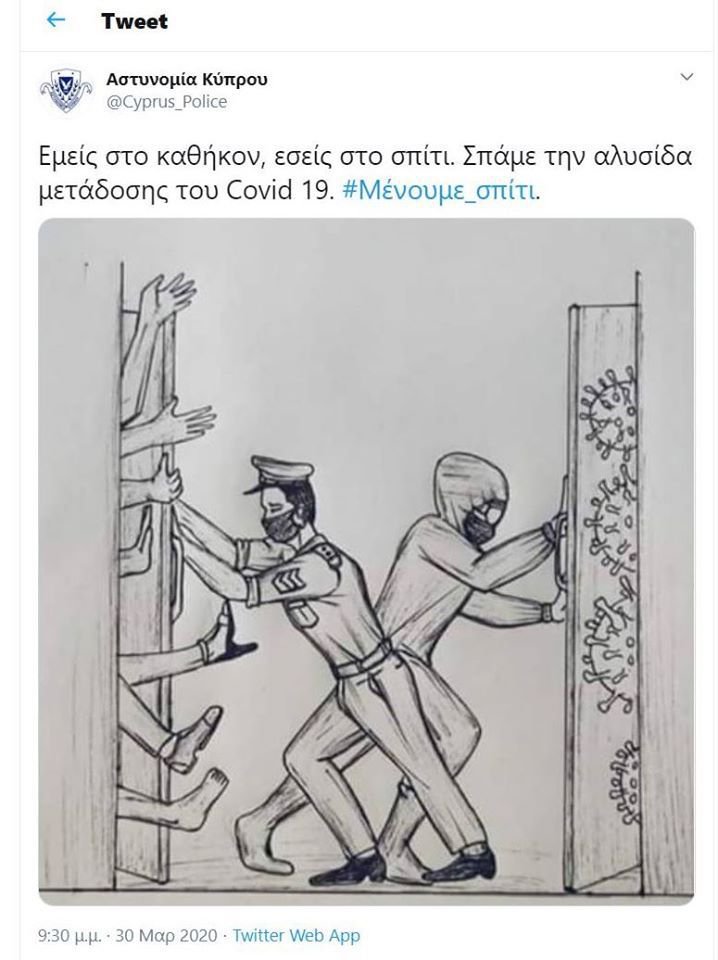
Twitter Cyprus Police 2
“We are on duty. You are in the house. We are breaking the transmission chain of Covid-19. #We stay at home” | Screenshot: Twitter: official account of the Cyprus Police, March 30, 2020.
This is a screen shot of the official twitter account of Cyprus Police on 30/3/2020 after the stricter lock-down measures were announced by the government. It was removed 3 hours later after a public outcry on social media. It was also discovered that the drawing was copied from another pre-existing graphic signed by ‘Miss Matured’ without attributing credit and thus possibly also infringing copyright law.
It is in such a context that the Minister of Interior of the Republic of Cyprus stated on television that “time will tell whether such measures are legal or not” and that the government establishes “new administrative structures and measures that are at the frontier of the law”. It is in such a context that the Police of Cyprus published the unacceptable image above in its March 30 tweet which in all its crudeness illustrates quite aptly how it imagines its role.
Although there has been some reaction to the police-state image communicated by the government, forcing it to a retreat, at least at the rhetorical level it remains to be seen whether the progressive section of society and the parliamentary opposition parties will continue to more or less tolerate the authoritarian drift operating as a cover for incompetence and public health system degradation or whether they will stand up to it, set limits to governmental arbitrariness, and hold it to account.
Returning to the bigger European picture, although Cyprus might be an extreme case, it does raise wider issues as to how authoritarianism may mask institutional failures diverting resources and attention from public health into police operations and substituting citizen for government responsibility. More importantly if authoritarianism is left unchecked to shape the public discourse, it can self-propel and legitimise itself, diverting the blame from the state onto society.

Παρασκευή 14 Φεβρουαρίου 2020

Gregoris Ioannou awarded Marie Sklodowska Curie Fellowship

We are delighted to announce that Dr Gregoris Ioannou has won a prestigious Marie Sklodowska Curie Fellowship. It is the first award of its kind for the School of Law as well as for the University of Glasgow’s College of Social Sciences.
Working under the supervision of Professor Ruth Dukes in the School of Law, Gregoris will use the two year fellowship to conduct research on Collectivism in the Digital Era: Novel Approaches to Worker Mobilization and Interest Representation (CODE).  Against a background of trade union decline throughout Europe, the CODE project examines examples of revitalisation: new forms of trade unionism and or worker mobilisation, that harness social media and other forms of digital technology to reach and communicate with workers, including young workers. Using mixed methods, including contextual analysis and comparison across jurisdictions, it aims to identify (i) what kinds of worker mobilisation and collective action have been and are likely to be successful in the current digital era, and (ii) how interest representation and workers’ empowerment might be enhanced.  In this way, it aims to make a contribution of real theoretical and practical significance to the reversal of trends towards weakened trade unions and growing inequalities of wealth and opportunity.
Gregoris joined the University of Glasgow in January 2019 to work as a Research Fellow on the ERC-funded Work on Demand project. In the intervening months, he has been conducting fieldwork in Greece and Scotland, analysing and comparing the experiences of young workers in precarious or insecure employment in the hospitality and catering sector. Prior to joining Glasgow, he was employed at the University of Cyprus and Frederick University, Cyprus. He holds degrees (BSc and MSc) from the London School of Economics and Political Science (LSE) and the University of Warwick (PhD).

Πέμπτη 6 Φεβρουαρίου 2020

Collectivism in the Digital Era: Novel Approaches to Worker Mobilization and Interest Representation (CODE)

We are delighted to announce that Dr Gregoris Ioannou has won a prestigious Marie Sklodowska Curie Fellowship.  Working under the supervision of Professor Ruth Dukes in the School of Law, Gregoris will use the two-year fellowship to conduct research on Collectivism in the Digital Era: Novel Approaches to Worker Mobilization and Interest Representation (CODE).  Against a background of trade union decline throughout Europe, the CODE project examines examples of revitalisation: new forms of trade unionism and or worker mobilisation, that harness social media and other forms of digital technology to reach and communicate with workers, including young workers. Using mixed methods, including contextual analysis and comparison across jurisdictions, it aims to identify (i) what kinds of worker mobilisation and collective action have been and are likely to be successful in the current digital era, and (ii) how interest representation and workers’ empowerment might be enhanced.  In this way, it aims to make a contribution of real theoretical and practical significance to the reversal of trends towards weakened trade unions and growing inequalities of wealth and opportunity.
Gregoris’ fellowship will begin in 2021, precise date to be confirmed. In the meantime, he will continue his WorkOD research on the experiences of young workers in precarious or insecure employment in the hospitality and catering sector.

Πέμπτη 24 Οκτωβρίου 2019

Όλγα Δημητρίου για τον "Ντενκτάς στον νότο"


Ο ΝΤΕΝΚΤΑΣ ΣΤΟΝ ΝΟΤΟ
Ομιλία στην παρουσίαση του βιβλίου στο Πανεπιστήμιο Κύπρου, 8/7/2019

Όλγα Δημητρίου,
Αναπληρώτρια Καθηγήτρια, Πανεπιστήμιο Durham

Το βιβλίο είναι ταυτόχρονα:
1.      Μια κοινωνικό-πολιτική ανάλυση
2.      Μια ανάλυση της νέας γενιάς του Κυπριακού
3.      Μια ακτιβιστική / προσωπική προσέγγιση

Προσφέρει μια προσέγγιση των τελευταίων ιστορικών γεγονότων από το 1974 μέχρι σήμερα, αλλά με εστίαση στο μετά του 2004. Σημείο αναφοράς το 2004, 2008 και 2017 που δεν έχουν ακόμα ιστορικο-ποιηθεί  επαρκώς και γι’ αυτό το βιβλίο είναι μια σημαντική συμβολή καθαρή, κατανοητή και ολοκληρωμένη ανάλυση που εξηγεί  εσωτερικές  και εξωτερικές παραμέτρους σε επίπεδο κοινωνικής και πολιτικής θεώρησης συσχετίζοντας τους όρους των Διεθνών Σχέσεων με την Κοινωνιολογία των ταξικών & κομματικών δυναμικών.

Κατά ένα μέρος όλοι όσοι ασχοληθήκαμε με το Κυπριακό χρειαστήκαμε να απλώσουμε τις αναλυτικές μας δυνατότητες σε ένα δια-κλαδικό φάσμα πολιτικής ανάλυσης & κοινωνικών σπουδών και  ο Γρηγόρης  αναδεικνύει  άψογα  την ολοκληρωμένη σκέψη & κατανόηση που αυτή  η προσέγγιση μπορεί να δώσει.

Η ανάλυση δομείται πάνω στο σχήμα της αποκάλυψης του “μυστικού”  της ε/κ  προσέγγισης στο Κυπριακό ως μια άρρηκτη συμφωνία μεταξύ κοινωνίας και πολιτικής ως  προς την αποδοχή της διχοτόμησης.  Αυτό σωστά παρατηρεί και είναι κάτι που είχε σημαδέψει την δική μας γενιά πριν αλλά ιδίως μετά το Δημοψήφισμα προσπαθώντας και εγώ να το κατανοήσω ως έκφραση της  επιτρέπουσας κοινότητας στη δική μου δουλειά, θα έλεγα πως είναι όντως το πιο χαρακτηριστικό της ε/κ κοινωνίας το πώς μαθαίνουμε να ζούμε με μια κατανόηση και αποδοχή πραγμάτων που δεν ξέρουμε. Από την δική μου εμπειρία και από το Πανεπιστήμιο και ίσως το σημαντικότερο μάθημα που πήρα από τους φοιτητές μου δεν ήταν η άγνοια του Κυπριακού αλλά η επίγνωση της άγνοιας. Η γενιά όχι μόνο του μετά-1974, όπως την νοηματοδοτεί και το βιβλίο αλλά και γενιές των μετά-βίας εποχών ( που είναι και ταξικά και έμφυλα ορισμένες) έχουν δεκτεί ότι κάποια πράγματα δεν θα τα μάθουμε. Ταυτόχρονα όμως μαθαίνουμε ότι ίσως δεν ωφελούν καν να ρωτούμε. Αλλά κυρίως να μαθαίνουμε ότι αυτό που γνωρίζαμε υπάρχει μόνο στη σφαίρα της ρητορικής ως performance. Η διαφοροποίηση μεταξύ συμβολικού και αληθινού είναι από πού ορίζει κατά ένα χρόνο υποστηρίζω την Ε/Κ ενηλικίωση.

Και αυτό με φέρνει στο 2ο σημείο αναφοράς το βιβλίο ως γενεαλογικό έργο. Να ξεκινήσω με μια παρερμηνεία την πρώτη φορά που διάβασα την αναφορά στο ότι μετά το 2003 “Η Κύπρος μεγάλωσε” το αντιλήφθηκα ως αναφορά στο ότι οι Ε/Κ ωρίμασαν ως πολιτικά υποκείμενα ( αν και ήξερα καλά την έκφραση ως αναφορά στο γεωγραφικό και  όχι πολιτικό μέγεθος). Αν και αναμφισβήτητα το 2003 ήταν μια ευκαιρία που έκλεισε με το 2004 αναρωτήθηκα πολλές φορές αν η άρνηση ήταν άρνηση (και) πολιτικής ενηλικίωσης. Και αυτό είναι ένα ερώτημα που η γενιά του Γρηγόρη και η δική μου ίσως μπορεί  καλύτερα να απαντήσει. Αν και δεν είναι ακριβώς ερώτημα του βιβλίου, θέλω να εξηγήσω πως ο Γρηγόρης μας βοηθά να το αναλύσουμε. Το ότι ανήκει στην μετά-πολεμική εποχή του επιτρέπει, πιστεύω να αρθρώνει ένα καινούργιο λόγο που μπορεί να χαρακτηριστεί ως μια “νέα γενιά” αναλύσεων του  Κυπριακού.

Σε αυτή βλέπω τα εξής χαρακτηριστικά:

Ένα κτίσιμο πάνω στην κριτική προσέγγιση όπου αναλύσεις προηγουμένων περιόδων είχαν πρωτοπορήσει  Νιαζί, Παπαδάκης, Μαυράτσας, Χατζιηπαύλου, Κωνσταντίνου κτλ – και ακριβώς επειδή ο πήχης της κριτικής τέθηκε ψηλά, η κριτική που καλού(μαστε) να προχωρήσουμε τώρα και δεν μπορεί πλέον μόνο να εξηγεί την σιωπή της Ιστορίας και να την αποκαλύπτει ως «μυστικό» αλλά να εξηγεί το πώς εμπεδώνονται πως χρησιμοποιούνται, και γιατί διαιωνίζονται ακόμη και μετά την αποκάλυψη τους. Η ανάλυση εδώ του Γρηγόρη για το πώς δουλεύει ο Λόγος του «εκάμαμεν τζιαί εμείς  πολλά» είναι άριστο παράδειγμα.

Ακριβώς επειδή αυτοεθνογραφική βάση την οποία κτίζουμε τις αναλύσεις μας σημαδεύτηκε από την εμπειρία της κανονικοποίησης των κλειστών συνόρων και την έκπληξη του ανοίγματος τους, η ανάλυση του Γρηγόρη είναι ένα μοναδικά καλό αλλά και ενδεικτικό παράδειγμα μιας ιδιαίτερης φιλοσοφίας στον αναλυτικό λόγο.  Κύριο συστατικό αυτής είναι η απόδοση του Άλλου-μάλιστα θα έλεγα ότι το βιβλίο σηματοδοτεί και την αρχή μιας βιβλιογραφίας όπου ο “Αλλος” με όρους μετα-αποικιακής κριτικής σταματά να υφίσταται αναλυτικά. Κοινοτυπίες για το τι έγινε όταν συναντήσα(με –όλοι) πρώτη φορά Τ/Κ δεν υπάρχουν στο βιβλίο, αν και ήταν σημαντικές να λεχθούν σε προηγούμενες εποχές. Οι Τ/Κ  για τον Γρηγόρη είναι  συγγραφείς, συνεργάτες, αναλυτές της δικής τους κοινωνίας αλλά και με ευρύτερο αναλυτικό εκτόπισμα μιας κοινωνίας βαθιά πολυσύνθετης σε πολιτικό και κοινωνικό βαθμό που ο συγγραφέας γνωρίζει, γιατί θέλησε να την καταλάβει ως μέρος της δικής του καθημερινότητας και όχι ως «έκτακτη ανάγκη» . Έτσι, αν και ξεκάθαρα μας λέει  ότι επικεντρώνεται στην Ε/Κ κοινωνία, η ανάλυση των Τ/Κ  «επί ίσοις όροις» μας δίνει ένα έξοχο καλούπι για την ανάλυση που έρχεται μετά το δικοινοτισμό.

Και  αυτό με οδηγεί στο τελευταίο σημείο που θέλω να αναδείξω, αυτό της ιδιότητας του συγγραφέα – ακτιβιστή. Εδώ θα διαφωνήσω με την παρουσίαση που κάνει του κειμένου ως γραμμένο μακρυά από τις γραμμές της εξεζητημένης ανάλυσης και με ύφος που να απευθύνεται σε ένα ευρύ κοινό. Είναι όντως ευκολοδιάβαστο και καλογραμμένο αλλά η απομάκρυνση από την σοβαρή ανάλυση που μας υπόσχεται δεν υπάρχει. Υπάρχουν καθαρά επιχειρήματα που αναδύουν και αναλύονται όχι επειδή παραλληλίζουν τις πολιτικές του πεποιθήσεις αλλά επειδή τις διαμορφώνουν π.χ  η ανάλυση των τάσεων της αριστεράς, η προσέγγιση των αφηγημάτων της δεξιάς, εθνικιστικής και φιλελεύθερης, η απεικόνιση των ρευμάτων στα οποία συμμετείχε ο Γρηγόρης (ιδιαίτερα οι βιβλιογραφικές αναφορές στα νεκατώματα) – όλα αυτά είναι μέρος σοβαρής και ευαίσθητης ανάλυσης που συνδέουν παραδειγματικά την πράξη με την θεωρία. Και άρα το βιβλίο δεν είναι μια πρόταση για το «ευρύ κοινό» αλλά μια πρόταση που παίρνει το  «ευρύ κοινό» στα σοβαρά. Και για αυτό αξίζει προσοχής από όλους μας.

Τετάρτη 26 Ιουνίου 2019

Παρουσιάσεις του βιβλίου «Ο Ντενκτάς στον νότο: Η κανονικοποίηση της διχοτόμησης στην ελληνοκυπριακή πλευρά» σε Λεμεσό, Πάφο και Λευκωσία


ΔΕΛΤΙΟ ΤΥΠΟΥ

Οι εκδόσεις Ψηφίδες σας προσκαλούν στις παρουσιάσεις του βιβλίου «Ο Ντενκτάς στον νότο: Η κανονικοποίηση της διχοτόμησης στην ελληνοκυπριακή πλευρά» του Γρηγόρη Ιωάννου σε Λεμεσό, Πάφο και Λευκωσία στις 5,6 και 8 Ιουλίου αντίστοιχα.

Δανειζόμαστε τα λόγια του καθηγητή Αλέξη Ηρακλείδη για να πούμε πως, [τ]ο βιβλίο “φιλοδοξεί να αρθρώσει μία γενική θεώρηση για το πώς κανονικοποιήθη­κε η διχοτόμηση» στους Ελληνοκυπρίους, κατά τα τελευταία 25 –κυρίως 15– χρόνια, και έτσι να φέρει στο φως ένα κρυμμένο αλλά «κοινό» μυστικό των Ελληνοκυπρίων.
Το βασικό επιχείρημα του βιβλίου είναι ότι «η εδραίωση της διχοτόμη­σης» δεν ήταν «αυτόματη», ούτε συνέβη «πίσω από την πλάτη» των Ελλη­νοκυπρίων. Ίσως πιο «σημαντική ήταν η απώθηση από πολλούς των συνε­πειών του ηχηρού Όχι» του 2004 και «η αδυναμία τους να επεξεργαστούν εναλλακτικές πρακτικές και άλλα σενάρια τα επόμενα χρόνια». Προσθέτει δε ότι «η απομυθοποίηση που επήλθε με τη διαδικασία του δημοψηφίσμα­τος σήμανε το τέλος της ομίχλης και μαζί και το τέλος της αθωότητας για όλους»: εννοεί βέβαια για τους Ελληνοκυπρίους που πριν εμφανιζόντουσαν διεθνώς ως διαλλακτικοί, ενώ οι Τουρκοκύπριοι αδιάλλακτοι υπό τον Ραούφ Ντενκτάς (
Rauf Denktas). Διευκρινίζει δε, ότι το σύνθημα «ο Ντενκτάς στον νότο» το φώναξαν οι Τουρκοκύπριοι «το βράδυ της ανακοίνωσης των αποτε­λεσμάτων του δημοψηφίσματος, αντιστρέφοντας έτσι τον εθνοκεντρισμό που εξέφραζε και υπηρετούσε ο Ραούφ Ντενκτάς και οι συνεργάτες του».


ΛΕΜΕΣΟΣ
ΑΜΦΙΘΕΑΤΡΟ «ΠΕΥΚΙΟΣ ΓΕΩΡΓΙΑΔΗΣ», ΤΕΧΝΟΛΟΓΙΚΟ ΠΑΝΕΠΙΣΤΗΜΙΟ ΚΥΠΡΟΥ (ΤΕΠΑΚ), 
ΠΑΡΑΣΚΕΥΗ 5 Ιουλίου, 19:30

Το βιβλίο θα παρουσιάσουν οι Αντρέας Παναγιώτου (κοινωνιολόγος, επιμελητής της «Κυπρολογικής Σειράς: Ρότσος»), Άδωνις Φλωρίδης (σκηνοθέτης), Νίκος Τριμικλινιώτης (κοινωνιολόγος), ενώ παρών θα είναι και ο ίδιος ο συγγραφέας του βιβλίου. Την συζήτηση θα συντονίσει η Μαρία Χατζημιχαήλ (ερευνήτρια).

ΠΑΦΟΣ
ΚΕΝΤΡΟ ΤΕΧΝΩΝ ΚΙΜΩΝΟΣ, Κίμωνος 2
ΣΑΒΒΑΤΟ 6 Ιουλίου, 20:30

(Η βιβλιοπαρουσίαση γίνεται σε συνεργασία με το Κέντρο Τεχνών Κίμωνος)

Το βιβλίο θα παρουσιάσουν οι Χρίστος Μάης (ιστορικός, εκδόσεις Ψηφίδες), η Σεβίνα Φλωρίδου (αρχιτέκτονας), ενώ παρών θα είναι και ο ίδιος ο συγγραφέας του βιβλίου.

ΛΕΥΚΩΣΙΑ
ΑΙΘΟΥΣΑ 109, ΚΤΙΡΙΟ ΧΩΔ01, ΠΑΝΕΠΙΣΤΗΜΙΟ ΚΥΠΡΟΥ (Πανεπιστημιoύπoλη)
ΔΕΥΤΕΡΑ 8 Ιουλίου, 19:00

Το βιβλίο θα παρουσιάσουν οι Όλγα Δημητρίου (αναπληρώτρια Καθηγήτρια Πανεπιστήμιο Durham), Niyazi Kizilyurek (ευρωβουλευτής, καθηγητής Πανεπιστημίου Κύπρου), Τάκης Χατζηγεωργίου (πρώην ευρωβουλευτής), Τάκης Χατζηδημητρίου (επικεφαλής Δικοινοτικής Επιτροπής για τη Προστασία της Πολιτιστικής Κληρονομιάς), ενώ παρών θα είναι και ο ίδιος ο συγγραφέας του βιβλίου. Την συζήτηση θα συντονίσει η Σούλα Χατζήκυριακου (δημοσιογράφος).


Ο Γρηγόρης Ιωάννου γεννήθηκε στη Λευκωσία το 1979, είναι κοινωνιολόγος και εργάζεται ως ερευνητής στο Πανεπιστή­μιο της Γλασκώβης.
Σπούδασε διεθνή ιστορία και πολιτική κοινωνιολογία στο
London School of Eco­nomics, πήρε διδακτορικό από το Πανεπι­στήμιο του Γουόρικ (Warwick) και έχει διδάξει στο Πανεπιστήμιο Κύπρου και στο Πανεπιστήμιο Frederick. Έχει δημοσιεύ­σει πληθώρα άρθρων για θέματα εργασια­κών σχέσεων, συνδικαλισμού, ταξικών και πολιτικών συγκρούσεων, κοινωνικών κινημάτων και για την οικονομική κρίση στη νότια Ευρώπη. Τα τελευταία 20 χρό­νια συμμετείχε σε πολλές δράσεις επανα­προσέγγισης Ελληνοκυπρίων και Τουρκο­κυπρίων και γενικότερα στο κίνημα ειρή­νης και επανένωσης της Κύπρου.

Στοιχεία Επικοινωνίας

+357 99675880
+30 6945073799


Κυριακή 12 Μαΐου 2019

Εισαγωγή του βιβλίου μου "Ο Ντενκτάς στο νότο: η κανονικοποίηση της διχοτόμησης στην ε/κ πλευρά"


Εισαγωγή: ιστορία, ανάγκη και επιλογές


Εάν, επιλέγουν να προστατεύσουν τα δικαιώματα των Τ/κ σε μια ξεχωριστή, ανεξάρτητη οντότητα, τότε θα πρέπει να περιοριστούν εις όσα αναλογούν στην αποκλειστική οικονομική ζώνη της εν λόγω παρανόμου οντότητας. Και συνεπώς δεν έχουν λόγο να αμφισβητούν τα κυριαρχικά δικαιώματα της Κυπριακής Δημοκρατίας.

 Νίκος Αναστασιάδης, 2/1/2018

Το παρόν βιβλίο είναι βασισμένο σε δυο δεκαετίες στενής παρακολούθησης της εξέλιξης του Κυπριακού, αρθρογραφίας και πολιτικής στράτευσης και δράσης ενάντια στη διχοτόμηση. Φέτος κλείνω τα σαράντα χρόνια ζωής και έγραψα αυτό το κείμενο στο Καϊμακλί, ένα σημείο στη Λευκωσία, που στις 3 από τις 4 πλευρές του ορίζοντα, μερικά χιλιόμετρα μπροστά μου, βρίσκεται η διαχωριστική γραμμή της χώρας μου με τη νεκρή της ζώνη. Μακάρι τα πράγματα να ήταν αλλιώς και σήμερα να ήμουν σε θέση να έγραφα ένα βιβλίο με τίτλο «Η ανατροπή της διχοτόμησης», ένα αίσθημα που είχα και την περίοδο 2003-2004 όντας μεταπτυχιακός φοιτητής Πολιτικής Κοινωνιολογίας στο Πανεπιστήμιο του Λονδίνου και έγραφα τη διατριβή μου πάνω στις τότε τρέχουσες εξελίξεις με το Σχέδιο Ανάν και το δημοψήφισμα. Τότε είχα ξεκινήσει με προκαταρκτικό τίτλο «Η ειρηνευτική διαδικασία στην Κύπρο», αλλά από την άνοιξη του 2004 ο τίτλος έγινε «Ερμηνεύοντας το ελληνοκυπριακό Όχι».

Απέφυγα να συνεχίσω συστηματικά σε ακαδημαϊκό επίπεδο την ενασχόλησή μου με το Κυπριακό και επέλεξα γενικά άλλα θέματα για την επιστημονική μου εργασία τα τελευταία 15 χρόνια. Αλλά η πολιτική δράση στο κίνημα της επανένωσης και η δημόσια αρθρογραφία μου παρέμειναν σε μεγάλο βαθμό προσανατολισμένες πάνω στη διερεύνηση και την προσπάθεια ανατροπής της διχοτόμησης – κάτι που θα συνεχίσει και μετά τη συγγραφή αυτού του βιβλίου. Καθότι το 2017 υπήρξε μια καθοριστική στιγμή στο Κυπριακό, ανάλογη με το 2004 και επειδή θεωρώ ότι τα διάφορα κομμάτια ανάλυσης που έγραψα σε διάφορες φάσεις αυτά τα 15 χρόνια έχουν σκιαγραφήσει ένα επαρκές πλαίσιο ανάλυσης, πιστεύω ότι ήρθε η ώρα να πάρουν μια πιο συνεκτική μορφή και να αρθρώσουν συνολικά ένα περιεχτικό επιχείρημα. Το βιβλίο αυτό απευθύνεται σε ένα διευρυμένο ακροατήριο και προσπαθεί να αποφύγει διάφορες ακαδημαϊκές συμβάσεις για να κρατήσει το κείμενο όσο το δυνατόν πιο βατό για τον μέσο αναγνώστη χωρίς εξειδικευμένες γνώσεις στις κοινωνικές επιστήμες ή σε βάθος γνώση του Κυπριακού.[1]

Ο στόχος του βιβλίου είναι να καταγράψει τις βασικές δυναμικές που διαμόρφωσαν το Κυπριακό μετά το 1974, ιδιαίτερα μετά το 1993, άλλη μια κομβική στιγμή στην πορεία προς τη διχοτόμηση. Δεν υιοθετεί μια ιστορική λογική, παρότι προσεγγίζει ιστορικά και αφηγείται περίπου χρονολογικά τις εξελίξεις. Η οπτική και η λογική του κειμένου εντάσσονται στο πεδίο της πολιτικής κοινωνιολογίας και προσεγγίζουν το Κυπριακό υπό το πρίσμα των σχέσεων εξουσίας στην κοινωνία, εστιάζοντας στη διάδραση μεταξύ πολιτικής ελίτ και κοινωνίας, πολιτικού συστήματος και κοινωνίας των πολιτών. Το βιβλίο εστιάζει στο ιδεολογικό πεδίο και αναλύει τις πολιτικές δυναμικές, ιδιαίτερα τις πρόσφατες, σε σχέση με την κοινωνία και την αποτύπωσή τους στη δημόσια σφαίρα. Επικενώνεται στην ελληνοκυπριακή (ε/κ) κοινότητα χωρίς όμως να παραβλέπει τις παράλληλες διεθνείς εξελίξεις αλλά ούτε και τις δυναμικές στην τουρκοκυπριακή (τ/κ) κοινότητα στον βαθμό που αυτές επηρέασαν ή ακόμη και συνέβαλαν στην πορεία προς τη διχοτόμηση.

Το ανά χείρας βιβλίο δεν φιλοδοξεί να παρουσιάσει μια συνολική και εκτεταμένη ανάλυση όλων των παραγόντων που διαμόρφωσαν το κοινωνικο-πολιτικό γίγνεσθαι στην ε/κ κοινότητα τις τελευταίες δεκαετίες σε σχέση με το Κυπριακό. Ούτε μπορεί να παραθέσει λεπτομερώς όλες τις παραμέτρους της εξέλιξης σύνθετων ζητημάτων όπως ο εθνικισμός, οι ειρηνευτικές συνομιλίες, οι διακοινοτικές σχέσεις και το διεθνές περιβάλλον. Έχει πολύ πιο περιορισμένη αναλυτική ατζέντα και πολύ πιο συγκεκριμένα ερωτήματα να θέσει. Έχει όμως τον φιλόδοξο στόχο να αρθρώσει μια γενική θεώρηση για το πώς κανονικοποιήθηκε η διχοτόμηση τα τελευταία 25, και ειδικότερα τα τελευταία 15, χρόνια. Ή για να τεθεί αντίστροφα, για το πώς η διχοτόμηση, σε μια περίοδο που ευάλωτη από γεωπολιτική, πολιτική και οικονομική άποψη, τόσο ως ισορροπία όσο και ως πλαίσιο, δεν αμφισβητήθηκε και δεν διαβρώθηκε επαρκώς. Το ανά χείρας βιβλίο έχει ως στόχο να θέσει με ειλικρίνεια το ερώτημα και να συζητήσει δημόσια και ανοιχτά ένα συγκαλυμμένο αλλά κοινό μυστικό. Η ανάλυση της κανονικοποίησης της διχοτόμησης στην ε/κ πλευρά ενέχει και ένα πολιτικό βάρος, αυτό της αντιστροφής μιας γερά θεμελιωμένης ιδεολογικής οικοδομής – για αυτόν όμως τον λόγο φέρει και μια αίσθηση απελευθέρωσης στον βαθμό που το πετυχαίνει.

Το βιβλίο χωρίζεται σε 7 κεφάλαια που πραγματεύονται διάφορες θεματικές εστιάζοντας σε περιόδους, κομβικά σημεία και πεδία που διαμόρφωσαν τους όρους κανονικοποίησης της διχοτόμησης. Το 1ο κεφάλαιο θέτει το ιστορικό πλαίσιο και εξετάζει τη δημιουργία της διχοτόμησης, εισάγοντας επίσης και εννοιολογικά ζητήματα σε σχέση με το πολιτικό σύστημα, το πολιτικό ισοζύγιο δυνάμεων και τις δυναμικές των ταυτίσεων και των ιδεολογιών σε επίπεδο κοινωνίας. Ουσιαστικά αφηγείται τις βασικές εξελίξεις της εικοσιπενταετίας 1950-1975 που οδήγησαν στον διαχωρισμό Ελληνοκυπρίων και Τουρκοκυπρίων. Το 2ο κεφάλαιο συζητά κοινωνιολογικά τον διαχωρισμό, όπως αυτός επιβλήθηκε σχεδόν απόλυτα την περίοδο 1975-2003, και τις συνέπειές του σε επίπεδο συλλογικής συνείδησης ανάμεσα στις δύο κοινότητες. Έχοντας σκιαγραφήσει τα βασικά ζητήματα που συγκρότησαν ιστορικά το Κυπριακό, τα επόμενα κεφάλαια που καταπιάνονται με τις πιο πρόσφατες εξελίξεις εμβαθύνουν την ανάλυση και συζητούν τις παραμέτρους της μη επίλυσής του.

Το 3ο κεφάλαιο εστιάζει στο άνοιγμα των οδοφραγμάτων και στη μεγάλη κοινωνική προοπτική που δημιούργησε το 2003, αλλά και στο πώς αυτή δεν κατάφερε να πάρει άμεση πολιτική μορφή με αποτέλεσμα να φθαρεί και να οδηγήσει ξανά στο περιθώριο εκείνες τις λογικές και τις δυνάμεις που άρθρωναν με επιμονή μια αντι-διχοτομική πολιτική στάση. Συζητά παράλληλα τη σημασία της ύπαρξης των ανοιχτών οδοφραγμάτων από το 2003 μέχρι σήμερα και την επίδρασή τους στις δια-κοινοτικές σχέσεις. Το δημοψήφισμα για το Σχέδιο Ανάν είναι το κεντρικό θέμα του 4ου κεφαλαίου λειτουργώντας ως πυλώνας πάνω στον οποίο στήνεται το βασικό επιχείρημα του βιβλίου: ότι η εδραίωση της διχοτόμησης δεν υπήρξε ούτε αυτόματη και εκ των πραγμάτων διαδικασία, ούτε συνέβη πίσω από την πλάτη της ε/κ κοινότητας. Δεν ήταν το ηχηρό Όχι στον Ανάν που εδραίωσε τη διχοτόμηση. Πιο σημαντική ήταν η απώθηση από πολλούς των συνεπειών του ηχηρού Όχι και άρα η αδυναμία τους να επεξεργαστούν εναλλακτικές πρακτικές και άλλα σενάρια τα επόμενα χρόνια. Όμως η απομυθοποίηση που επήλθε με τη διαδικασία του δημοψηφίσματος σήμανε το τέλος της ομίχλης και μαζί και το τέλος της αθωότητας για όλους.


Το 5ο κεφάλαιο  συζητά την ύστατη μάχη που δόθηκε μεταξύ ομοσπονδίας και διχοτόμησης τη δεκαετία 2007-2017 σε πολιτικό επίπεδο και το πώς, παρά τη φαινομενική νίκη των δυνάμεων της ομοσπονδίας, ήταν τελικά οι δυνάμεις της διχοτόμησης που κατάφεραν πραγματικά να επικρατήσουν και να ορίσουν το παιχνίδι. Ανασκοπεί τις εσωτερικές δυναμικές στις δύο κοινότητες, τις διεθνείς μεταβολές και τις εξελίξεις στις διαπραγματεύσεις μέχρι την κατάρρευση του τελευταίου γύρου συνομιλιών το 2017, κάνοντας διάκριση μεταξύ της τυπικής και της ουσιαστικής στάσης των διαφόρων πρωταγωνιστών, της μορφής και του περιεχομένου των δράσεων σε πολιτικό και κοινωνικό επίπεδο. Στη συνέχεια, το 6ο κεφάλαιο εστιάζει στον ρόλο που διαδραμάτισαν ή μη η παιδεία και τα ΜΜΕ τόσο διαχρονικά όσο και σε κομβικές στιγμές της εξέλιξης του Κυπριακού ανοίγοντας έτσι τη συζήτηση για τις δομές και τους θεσμούς της Κυπριακής Δημοκρατίας της εκτάκτου ανάγκης και την επίδρασή τους πάνω στη συλλογική μνήμη, τις κοινωνικές αντιλήψεις και την κοινή γνώμη. Η κεντρική θεωρητική έννοια εδώ είναι το ιδιότυπο βαθύ κράτος που διαμορφώθηκε ιστορικά και αναπαράγεται συντηρώντας συγκεκριμένα κυρίαρχα ιδεολογικά και πολιτικά πλαίσια που επιδρούν σε παρόντα πολιτικό χρόνο.

Τέλος το 7ο κεφάλαιο ανοίγει την αναλυτική οπτική και συζητά πιο θεωρητικά τα προλεχθέντα και πιο συγκεκριμένα τις πολιτικές ισορροπίες και τα πολιτικά διακυβεύματα όπως διαμορφώθηκαν από τις πρόσφατες εσωτερικές και διεθνείς εξελίξεις. Πραγματεύεται τις ταξικές και πολιτικές ισορροπίες μέσα στην ε/κ κοινωνία, περιγράφει συνοπτικά τις αριστερές προσεγγίσεις και συζητά τις διάφορες γραμμές, θέσεις και σχεδιασμούς της ε/κ αστικής τάξης και τον συσχετισμό τους με τα λαϊκά και εργατικά στρώματα. Ο στόχος εδώ είναι η επεξήγηση των μετατοπίσεων, της νομιμοποίησης των πολιτικών και της αδυναμίας συγκρότησης ενός εναλλακτικού ιστορικού μπλοκ που θα μπορούσε να ανατρέψει τα διχοτομικά δεδομένα.

Στον επίλογο γίνεται μια απόπειρα να τεθεί με ιστορικούς όρους η προβληματική του βιβλίου και να γίνει μια ψύχραιμη αποτίμηση της επίδρασης που είχαν οι δρώντες διαχρονικά στην παραγωγή και αναπαραγωγή των δομών της διχοτόμησης. Αυτό αποτελεί, κατά τη γνώμη μου, υποχρέωση προς την επόμενη γενιά που έχει καταδικαστεί να ζήσει σε ένα επισφαλές περιβάλλον, σε ένα πιθανότατα επιδεινούμενο διχοτομικό στάτους κβο, όπου η διατήρηση της ειρήνης θα συνεχίσει να εξαρτάται απόλυτα και αποκλειστικά από τις διεθνείς ισορροπίες. Αξίζει να λεχθεί ότι η κατάσταση πραγμάτων, όπως διαμορφώθηκε το 1974, το εδραιωμένο διχοτομικό στάτους κβο δηλαδή, βασισμένο εσωτερικά στον εθνικισμό και τον φόβο, δεν παρέχει καμιά ασφάλεια σε συνθήκες μεταβολής αυτών των διεθνών ισορροπιών: ότι η μη λύση παγιώνει την υπαγωγή της Κύπρου στο πλέγμα των ιμπεριαλιστικών σχέσεων. ότι χωρίς την επανένωση της Κύπρου και την ανάπτυξη της συνείδησης και της πραγματικότητας των κοινών συμφερόντων Ε/κ-Τ/κ κινδυνεύουμε να ξαναγίνουμε το σημείο εξαγωγής της έντασης των ελληνο-τουρκικών μεγαλο-ιδεατισμών και του ανταγωνισμού τους.

Όσον αφορά την επιλογή του τίτλου αυτού του βιβλίου: Η ιδέα ότι το όραμα Ντενκτάς βρήκε μισό αιώνα μετά πολλούς υπέρμαχους στην ε/κ κοινότητα δεν είναι ούτε καινοφανής. Το ίδιο ισχύει και για τη διαπίστωση της κανονικοποίησης της διχοτόμησης. Αυτά έχουν λεχθεί πολλές φορές σε συγκεντρώσεις, έχουν γραφτεί σε άρθρα και έχουν εκτεθεί στη δημόσια σφαίρα. Αυτό όμως που δεν έχει γίνει μέχρι στιγμής είναι η σε βάθος ανάλυση και η συγκεκριμένη λογική και εμπειρική τεκμηρίωση αυτού του ισχυρισμού. Αυτός είναι ο διανοητικός στόχος του παρόντος βιβλίου. Το σύνθημα «ο Ντενκτάς στον νότο» το φώναξαν τα πλήθη των τ/κ του Ναι το βράδυ της ανακοίνωσης των αποτελεσμάτων του δημοψηφίσματος, αντιστρέφοντας έτσι τον εθνο-κεντρισμό που εξέφραζε και υπηρετούσε ο Ραούφ Ντενκτάς και οι συνεργάτες του. Να πάει στη νότια Κύπρο λοιπόν, εκεί που το διχοτομικό στάτους κβο έχει πιο πολλούς οπαδούς. Τις τελευταίες δύο δεκαετίες η ε/κ κοινότητα υπήρξε το κυρίαρχο πεδίο μέσα στο οποίο παίχτηκε και κρίθηκε το πολιτικό ζήτημα – αν το διχοτομικό στάτους κβο που διαμορφώθηκε το 1974 θα υπονομευόταν και θα ανατρεπόταν ή θα εδραιωνόταν.

Κλείνοντας αυτή την εισαγωγή θα επαναλάβω ότι η ιστορία δεν έχει τέλος και τα πάντα μπορούν να αλλάξουν. Το μέλλον της χώρας θα εξαρτηθεί τελικά από τους ανθρώπους της και τη δράση ή την αδράνειά τους –οι άνθρωποι φτιάχνουν τη δική τους ιστορία– σύμφωνα και με την περίφημη ρήση του Μαρξ. Σε συνθήκες όμως «δοσμένες από το παρελθόν». Αυτές τις συνθήκες από το παρελθόν είναι που καταγράφει αυτό το βιβλίο, με ρεαλισμό και μακριά από ευσεβοποθισμούς που μπορεί να θολώσουν την ανάλυση. Με άσβεστη όμως και την επιθυμία της ανατροπής της εδραίωσης της διχοτόμησης που αναδεικνύει το βιβλίο. Διότι πιστεύω ότι η «όποια διχοτόμηση», προς την οποία εργάζεται η κυρίαρχη μερίδα της ε/κ ηγεσίας και που γίνεται αποδεχτή ή/και επιθυμητή από ισχυρή μερίδα των ε/κ, δεν θα είναι ούτε βελούδινη, ούτε συμφέρουσα ούτε θα λύσει το πρόβλημα, που θα συνεχίσει να μας στοιχειώνει, έστω και αν τα επόμενα χρόνια επιβληθεί κάποια ρύθμιση στις εξωτερικές του πτυχές.


[1] Για να βοηθηθεί επιπλέον ο αναγνώστης, στο τέλος του βιβλίου περιλαμβάνεται ένα Επεξηγηματικό Γλωσσάρι στο οποίο μπορεί να ανατρέχει για κάποια βασικά ονόματα και όρους.